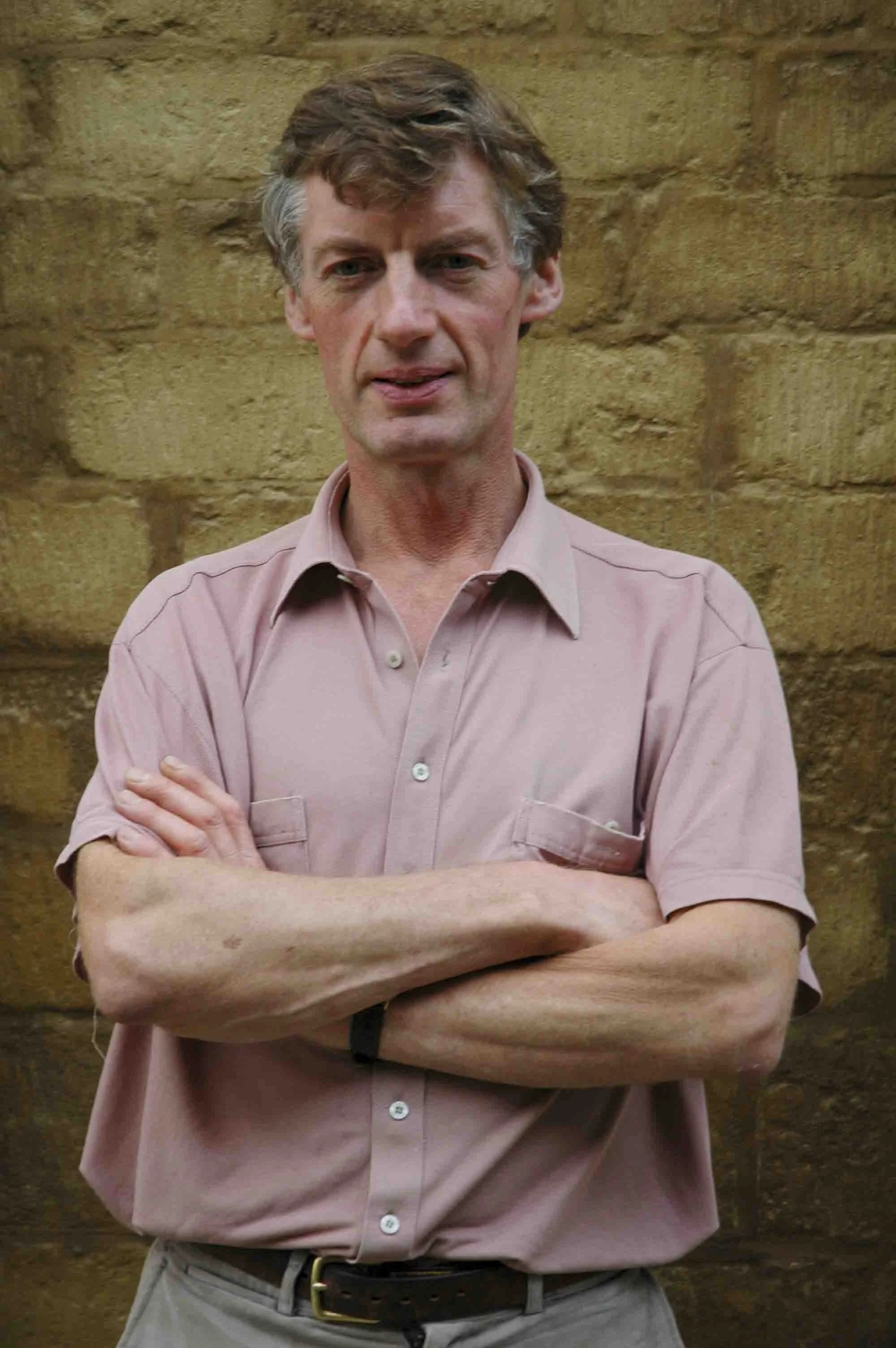
Rory Young - Artist and Craftsman
Rory Young was an extraordinary man, some say he was a 21st century William Morris. His skills and talents extended over many crafts and his love of traditional buildings inspired a generation. He leaves behind numerous exquisitely executed projects in houses, churches and cathedrals all over the country, including the West Door of York Minster and the Seven Martyrs in St Albans Cathedral. During his lifetime he kept meticulous notes, diaries, sketches and photographs which now form the basis of a unique archive.
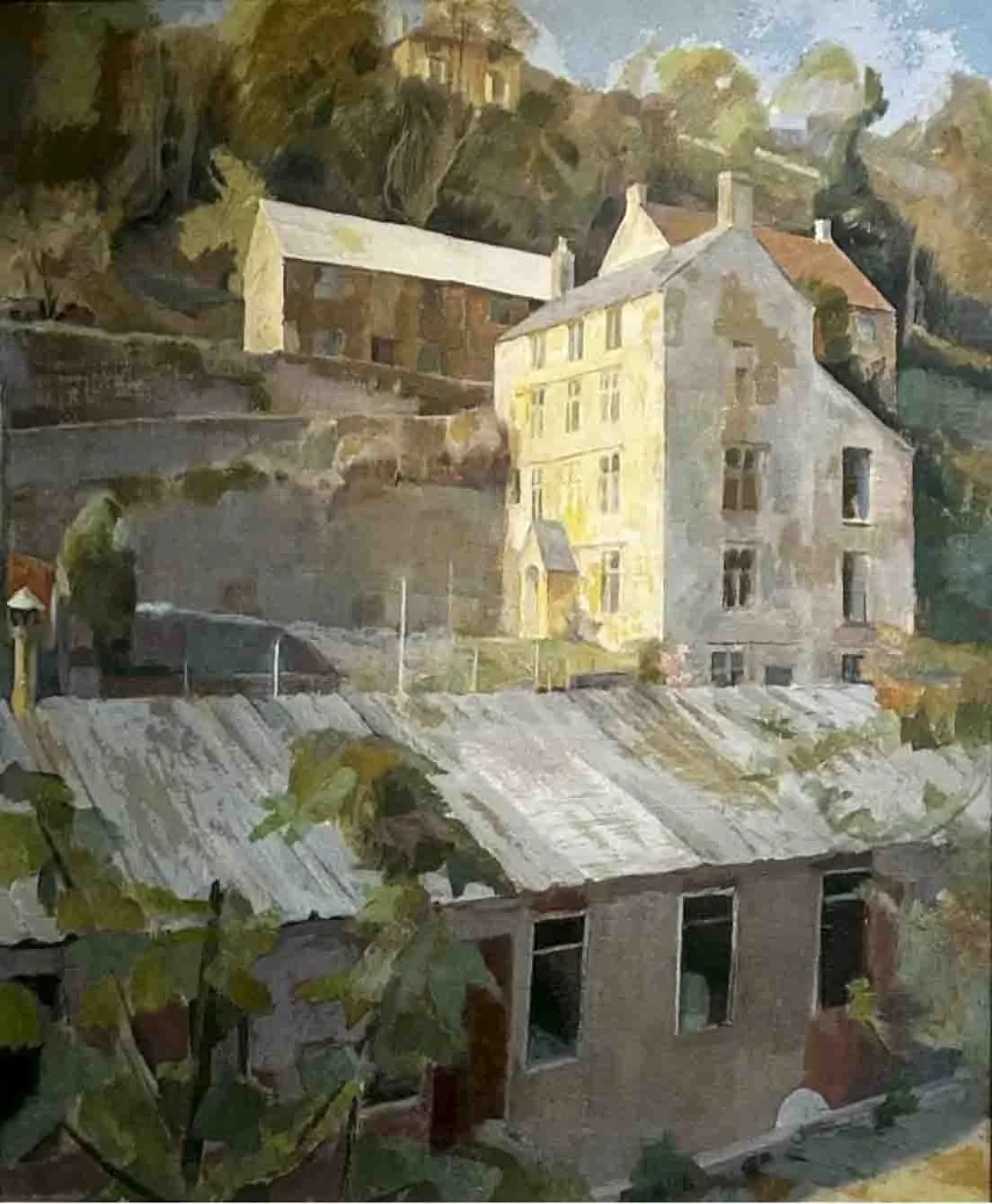
Art College & A Journey North
After a foundation course at Gloucestershire College of Art and Design, in Cheltenham, Rory went to London to study for a degree in fine arts at the Camberwell School of Arts and Crafts, where he also studied sculpture, while expanding his childhood interest in buildings. Having finished his degree in 1976 and armed with the Blue Guide to England and a tiny Fiat van, he set out on an eight-month study tour of the Midlands, north Wales and the north of England.
The intention was to visit and paint parts of the county he had not yet seen. Instead, his fascination with buildings of all levels of sophistication, led to him producing an illustrated diary, which in the words of the author and journalist Mary Myers – “…is a beautifully observed recording of an England that has changed: it should not stay unpublished.”
This trip proved to be defining period in Rory’s life, during which his focus shifted from painting to buildings, triggering a life-long study of architecture and vernacular construction. As observed by Mary Myers, it also uncovered another of his many skills, as a writer. Some years later he would write of this trip: “…in particular I studied churches, houses, townscape and both rural and industrial landscapes. Everywhere I looked at the surface treatment of old walls, and also gradually extended my knowledge of vernacular building traditions and architectural history. I have a love of and an inexhaustible fascination for traditional buildings that were devised and contrived by craftsmen with art and skill. I believe that even the humblest buildings reflect the spirit of those men who made them with such energy and commitment.”
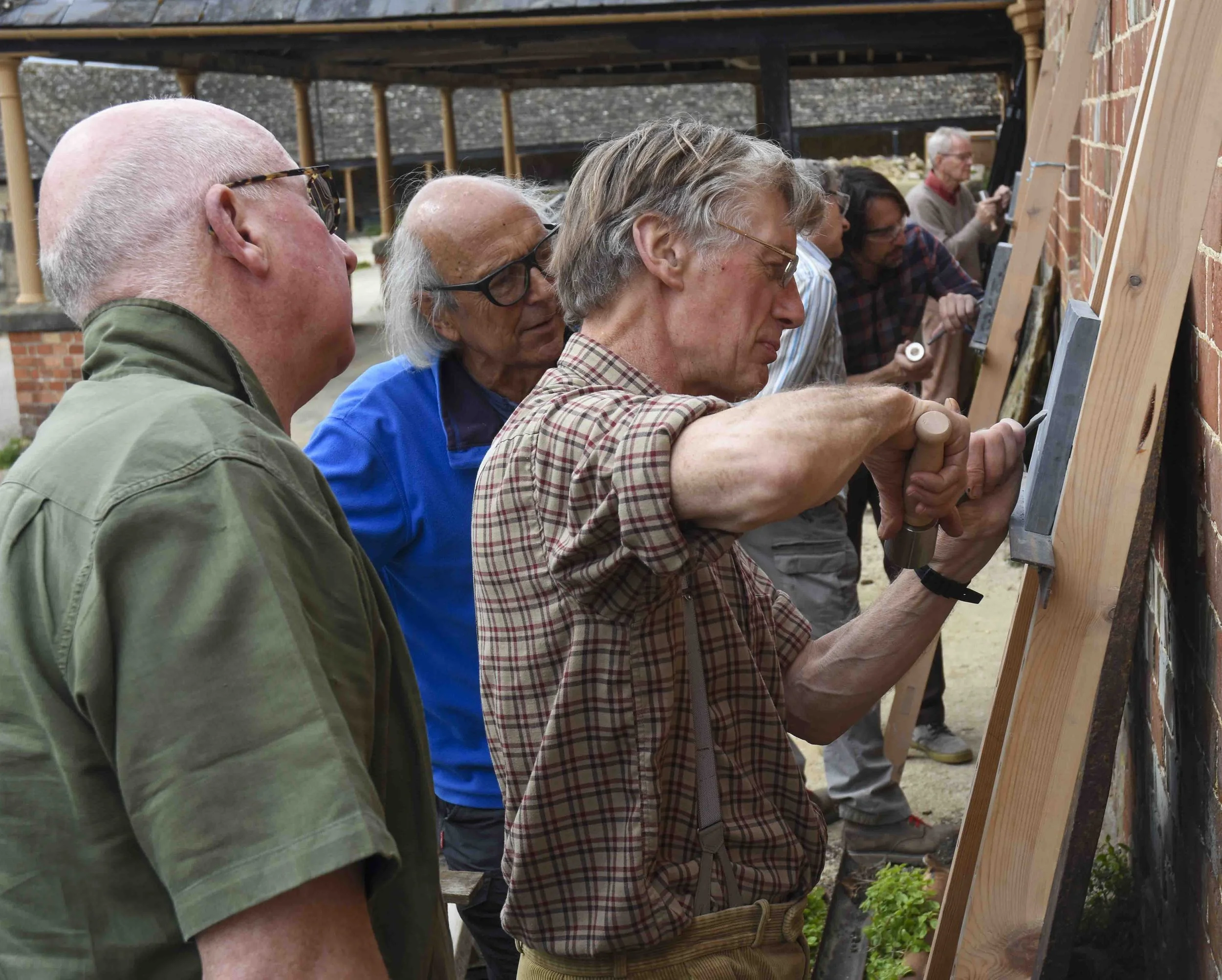
Out in the world of work and earning a living Rory’s earliest jobs were building dry stone walls and mortared walls in brick and stone. In 1978-9 he designed and built a two-storey masonry gazebo at Norbury Manor in Derbyshire, with an ornamental fibrous plaster ceiling cast on site.
During this time, he attended weekend courses on stone masonry, carving and lettering at the Orton Trust, and attended conservation courses in Oxford, Vienna, Czechoslovakia, and finally for three months at the ‘Centro Europeo Artigiani’ on the Island of San Servolo in Venice.
Letter cutting commissions started in the early 1980s and have been a regular source of work for over forty years. His hand carved inscriptions can be found in Oxford colleges, Westminster Abbey and in dozens of graveyards around Britain. He is regarded as a fine letterer and letter cutter with inventive designs and a very good eye. In later years, due to the high number of commissions, he has become more a designer of memorials with many of his designs now cut by other skilled craftsmen.
Wall Builder & Letter Cutter
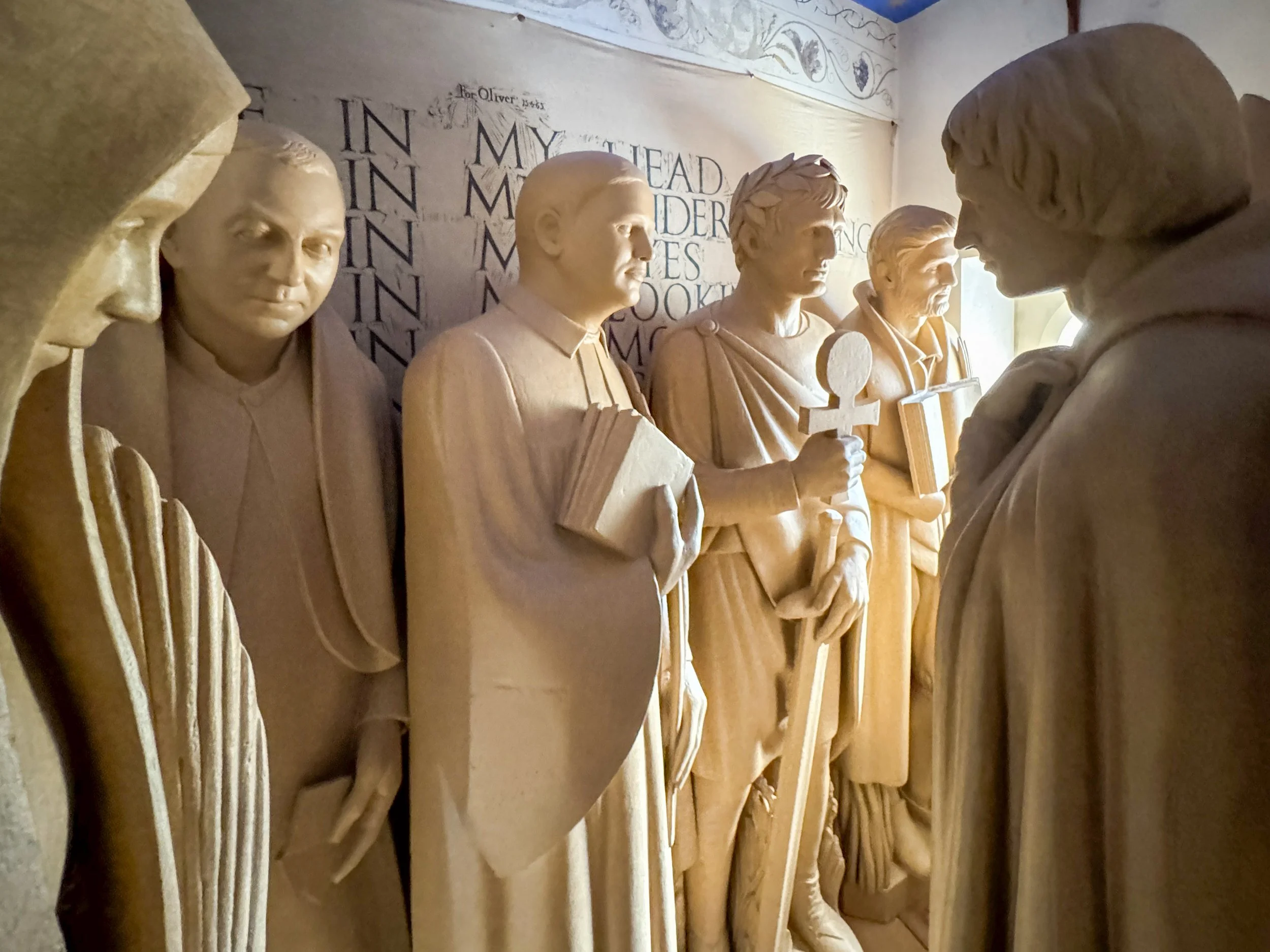
It is probably in the field of stone carving that Rory is best known today. Having started designing and cutting letters, into stone plaques or headstones, he evolved into more complicated inscribed memorials and finally into figurative sculpture. Early commissions included St Francis and the Wolf for Minchinhampton Church, St Cyr in the parish church of Stinchcombe and a full-sized sculpture of Nathaniel Woodard, founder of his secondary school of Kings College, Taunton. Higher profile commissions followed such as the Feilden Memorial ‘Christ and the Centurion’ in Gloucester Cathedral; the Genesis Cycle west doorway of York Minster and the Seven Martyrs in St Alban’s Cathedral.
The York Minster commission included sixteen small animated figurative groups framing the great west door, which replaced fourteenth-century work that had eroded to a state that was beyond recognition. These include the Creation, several of Adam and Eve, Cain and Abel, Noah’s Ark, the Tower of Babel, right through to Abraham with Isaac on the sacrificial pyre. For this commission Rory modelled each design in clay; these were then moulded and cast to be copied faithfully by the Minster’s carvers. The Minster stone yard is a great repository of high-level skills in stone cutting and carving. The designs are contemporary in spirit but sit very comfortably in their ancient setting. A night-time viewer described the work as: ‘Mr Young’s bold iconostasis, bathed in moonlight, reads like a silent prayer in stone.’
His greatest carved work is undoubtedly his group of Seven Martyrs that now stand in the niches of the fifteenth-century rood screen of St Alban’s Cathedral. These span across the centuries from St Alban, the first British martyr, to Bishop Oscar Romero. They were carved in Caen stone and then painted in bold polychromy, reviving an almost lost tradition rarely seen in Britain since before the Reformation. Underpinned by scrupulous research, endless maquettes and full-scale models, the work took five years to complete and is one of the most impressive interventions to an ancient British Cathedral during the modern era.
Rory’s approach to his work in ancient churches and cathedrals is typically modest: ‘I believe in the anonymity of the mediaeval tradition; I’m proud to have made something that is not so much an individual artwork, as part of the aggregation of effort that has created these buildings over centuries.’ While much of his carved work is figurative he has also designed and carved more abstract pieces like his much loved ‘A Celebration of Hands’ which was commissioned by the Cirencester Civic Society to adorn the New Brewery Arts Centre in his home town. Measuring approximately 1.5m x 1.5m in size, the work features a total of eighteen hands, working independently or in collaboration, on nine different crafts united by a flowing ribbon of fabric that represents the woollen industry, which brought such wealth to the town in mediaeval times.